Addressing Domestic Violence in Antenatal Care Environment (ADVANCE) Study
The ADVANCE study is a collaboration between
Kathmandu Medical College (KMC) and the
Faculty of Medicine, Norwegian University of Science and Technology (NTNU), Trondheim, Norway,
funded by the Norwegian Research Council FRIPRO Grant.
Principal Investigator: Prof. Dr. Sunil Kumar Joshi, Head of Department of Community Medicine
ADVANCE 1 (2013 – 2018)
The first phase of the study, ADVANCE 1, was a collaborative project between
NTNU (Norway), Kathmandu Medical College, and the
Kathmandu University School of Medical Sciences.
This study successfully explored the issue of domestic violence in pregnancy and its impact on maternal and perinatal outcomes.
ADVANCE 2 (2020 – 2025)
Following the success of ADVANCE 1, the research team from NTNU and KMC received the prestigious
Norwegian Research Council FRIPRO Grant to continue the project with
ADVANCE 2.
- Principal Investigator (Nepal): Prof. Dr. Sunil Kumar Joshi, Head of Department of Community Medicine
- Postdoctoral Researcher: Dr. Poonam Rishal, KMC graduate and PhD holder from ADVANCE 1
- PhD Candidate: Dr. Pratibha Manandhar, Assistant Professor, Department of Community Medicine
Rationale
Domestic violence in pregnancy is linked to a range of adverse maternal and perinatal outcomes.
The burden in Nepal is high, yet most existing screening instruments and interventions were developed in
high-income country contexts. There is a strong need for locally adapted and culturally sensitive approaches.
Project Goals
The ADVANCE 2 project aims to:
- Validate a culturally sensitive, Nepalese-language clinical screening instrument for identifying women living with domestic violence;
- Develop and implement a safety-promoting intervention suitable for routine antenatal care;
- Conduct a randomized clinical trial (RCT) to evaluate the effectiveness of screening and intervention compared to standard antenatal care;
- Carry out a process evaluation to understand contextual factors influencing women’s ability to seek and receive help;
- Assess the feasibility and relevance of using the tool and intervention in remote and rural settings of Nepal.
Key Objectives of ADVANCE 2
- To improve the safety-promoting intervention and compare it with other types of intervention in a randomized controlled trial (RCT);
- To validate the assessment instrument for antenatal care settings and explore the usability and impact of its electronic delivery.
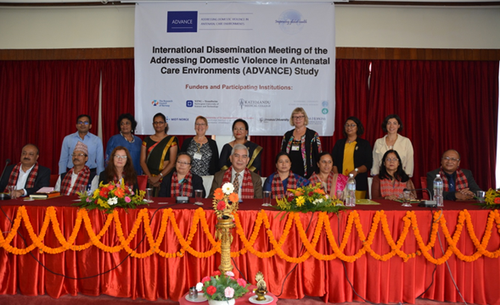
International Dissemination
An international dissemination meeting of the ADVANCE study was held on
2nd October 2018.
Learn More
For details on research activities under ADVANCE 1 and 2, please visit:
https://www.ntnu.edu/advance